
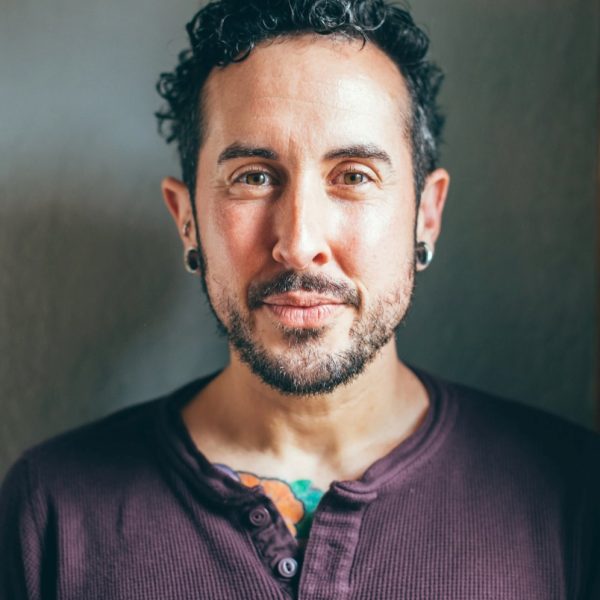
Oh, how to explain what’s my deal? Well, I’m a 42-year-old transgender man, and so for me that means that I was assigned female at birth. I was born with all the anatomy and parts that are typically associated with young girls and women in our society.
I knew that I was a man – I didn’t have language for it, so I probably didn’t really know until I was like 19 or 20 ’cause I’m old. Although in high school they frequently joked that I was a gay man trapped in a woman’s body, which in retrospect is very funny because essentially I was a gay man trapped in a woman’s body.
Yeah, I never wanted children. In fact, when I went to get on testosterone, the doctor made me sign a form that said I acknowledged that testosterone would render me sterile. He said, yes, it will render your uterus an “uninhabitable environment.” And even though it’s been over 20 years, I still remember the uninhabitable environment language was so stark. Of course now I know that that was not true 20 years ago. It’s not true today. It’s never been true. And sometimes, I still get messages from trans folks all over the world who are still being told that by physicians or nurses or, you know, other people. It’s never been true. There’s dozens if not hundreds of stories to refute that.
HRS: And now you have a doctor who doesn’t say things like that?
Correct. Well, no doctor that I would ever see would say something like that because I now screen very carefully for my medical providers. I have to be very picky about who I trust, my body and my health too.
HRS: That’s a whole other tangent, like, how do go about finding that kind of a doctor that is knowledgeable?
You know, as a trans man of a certain age, it’s become really easy for me to identify medical providers who are knowledgeable or not, quite frankly, by the questions they ask me. At one point I had a provider, I had stopped taking my testosterone, which you have to do if you would like to conceive and carry a pregnancy to term. So I had stopped taking my testosterone. My cycle hadn’t yet returned. And so I went to an endocrinologist, which is ostensibly the type of doctor you go to, to deal with hormones. And she said, “well, if you went off of testosterone, why hasn’t your beard fallen out?” And any provider with any knowledge about transgender health will know immediately that some of the effects of testosterone are largely irreversible, and facial hair is one of them.
HRS: So I had no idea either. I didn’t know that. I mean, but it’s not even a thing I would’ve thought about. So I think that’s interesting.
Well, it logically makes sense the effects of testosterone on the body, because think about for transgender women. If you’re assigned male at birth and your body has already produced testosterone, it’s made your voice deeper, it’s made you have facial hair. Those are irreversible things. It’s why transgender women often have a much harder time transitioning than transgender men do, because testosterone’s permanent. You can’t un-be that tall. You can’t make your hands any smaller. You can’t get rid of an Adam’s apple without surgery. You can’t change your voice without having to learn how to pitch it differently. It’s permanent. Same thing with electrolysis and facial hair – body hair removal. It’s painful and hard because testosterone is a very potent hormone.
HRS: So you saw this doctor and then what happened?
Well, when I saw a physician when I was like 20, 21, 22, somewhere around there, and he said, sign here to become sterile. I happily signed there. I never wanted to have kids, never wanted to be a parent. That seemed really boring and stupid to me. I had planned to be a Broadway star and then to tour the country and as many shows as possible. I just had no interest in a marriage, kids, family house. No. Pass. Yeah.
And so I didn’t really think about it for years.
I transitioned while I was in performing Arts Conservatory. It was just sort of like bumbling along in my life. I eventually did hit a place around 2008 where I was like, okay, being lonely is not great. I very much did want a partner at that point. I was working on the gay marriage campaign in California, the No on Proposition 8 campaign, and I was a national organizer traveling the country, helping communities who are facing these kinds of anti-gay, anti-trans attacks at the ballot box. And it started to become a real pain point that I’m here, like, fighting for gay marriage when I just assumed that that would never happen to me, even though I really wanted it to. Because I just didn’t think anyone would ever love me and I didn’t have any – I had zero evidence to the contrary. I had no reason to believe that the world had much to offer a transgender person in terms of love and support. I just didn’t have any models really for it. You know, this is pre, pre, pre, pre, like, I think all we had at that time probably was, Chaz Bono. I think we just had Cher’s trans son, and Boys Don’t Cry, but those were literally the only two public trans stories I was aware of.
HRS: What about in your personal life? Who was your support system at that point?
Yeah, I mean, I’ve always been surrounded by really wonderful, loving, supportive trans people, , particularly, trans men who were older than me, like 5, 10 years older, who were able to help me through a lot of my process. But most of them also were not in relationships. The straight transgender men had a really hard time finding women who were open to them having a different body than they were used to. The gay trans men, like me, had a really hard time finding gay men who were open to a body that was different than what they were used to, you know? And so there’s just always those struggles. And at that point we knew the dangers of being stealth or not telling anyone you’re trans. And that’s not something I was ever interested in doing, is hiding it somehow. That seemed very dangerous to me. Even being a gay trans man back then was very overwhelming and befuddling for people. Most gay men that I met had no idea what that meant. There wasn’t like a dropdown on the dating websites, you know what I mean? There was nothing like that. Nothing. ‘Cause this is a long time ago.
But just a couple years later, I met Biff, who is still my partner. It’ll be 15 years next month that we’ve been together. And here was someone who absolutely loved me without reservation, without compromise or apology, was proud to be with me and it was amazing.
And very early on in our courtship, I started to have dreams about a baby.
I did not tell Biff at the time, ’cause you don’t tell someone you’ve been on three dates with like, “oh, I’m having dreams where I see our baby.” Like, that’s, that’s not good judgment.
And we knew lots of trans men who’d had babies at that point. You know, it was certainly not something that was unheard of. But Biff was on more like a 10 year kids’ timeline. I was more like a 5 year kids’ timeline. But watching Biff with his nieces and nephews just awakened a part of me that I didn’t think was there. So I thought maybe down the road we could have a baby, but then life smacked us in the face.
HRS: What happened?
We ended up becoming emergency guardians for Biffs sister’s kids, our niece and nephew. So about a year into our relationship we were parents.
If you can imagine a parent going from zero to two kids with zero planning, zero preparation and no support. That’s what we did. I don’t have any regrets. However, I do not recommend that method of parenting.
HRS: Oh my God.
Yeah, it was awful.
HRS: Okay, so you’ve been raising these two kids and then at some point you…
We had a really, really challenging adoption process. Their first family struggled with drugs and poverty and addiction and abuse and were sometimes around, fighting for them, particularly after their state funding got cut – their food stamps and things like that. Once the state realized the kids are not in their care, they stopped giving them money for them and that’s when they started showing up to the court dates and things like that.
So it was really awful. It gutted us emotionally, financially. It was almost literally like building a plane while flying. We’re trying to raise these kids while also protecting them legally. And it was, yeah, it was just awful. But then finally there was an end in sight. There was a permanent, like termination of parental rights, adoption.
We spent years trying to get their first family the support they needed to be able to take the kids back. We know that’s best for kids. And it just never happened.
So as things finally settled down, the dreams came back and I started imagining us growing our family, not at the expense of somebody else losing a child, which is ultimately – unless a parent dies – ultimately, that is what adoption is. It’s part of why it’s so incredibly insulting for people who are trying to have biological kids. People experiencing infertility struggle with this. All queer people struggle with this. People will say, “well, why don’t you just adopt?” That word just is doing way too much work there. Because I think it’s really woefully, understating the trauma of what it means to become a parent at the expense of somebody else no longer being a parent.
That was really hard. And I felt that we had more to give, but I didn’t wanna do it in that way again.
HRS: And what are you seeing for your kids – the impact that it’s had on your adopted kids?
It’s hard to say the impact on adoption on any individual kid because there’s so many variables. One of my kids struggles with attachment. Is that because their parents functionally abandoned them? And the people who are raising them were not the people who were supposed to love and care for them, which is how our systems are wired? Or is it because they were neglected and abused in that home? Like who knows? Who knows? So it’s really hard to piece apart. But both of our kids have their own unique strengths and both of them have their own unique challenges, some of which are likely to be lifelong and will continue to need certain levels of care, support, love and attention.
I think one gift it’s given my kids is they’ve never been judgmental about other family structures.
Their cousin who actually has the same birth mom that they do as being raised by her grandparents, and my kids have never judged that or said anything bad or negative. You know, like single parents, grandparents raising kids, uncles raising kids, like they’ve just never had any judgment about that ’cause they know that family can show up in all kinds of ways in similar ways and that level of acceptance and openness carries over. They’ve just never been bigoted kids. They’ve never been kids who have a lot of bias. That’s just not part of who they are.
People often ask, “well, why would a trans person wanna be pregnant?” And the data shows that for most of us, the majority of us, it’s sheer practicality. It’s the way we could have a baby. It’s not that we wouldn’t have had a surrogate if we had $300,000 to spend on that, and if we agreed with the ethics of it. It’s not that, we wouldn’t have happily welcomed a child into our home. I did that. But for most of us, this is the most straightforward way to do it.
Some people feel called to have a baby. That does seem to transcend gender in those ways. But my guess is there’s a lot of non-trans men who would love the experience of creating life if they had that as an option. And they just don’t happen to, so you don’t hear about it as much. I think for as many wide, diverse and varied reasons as anybody else wants to have a baby, we do.
But yeah, the idea took root and I tried to anticipate what pushback am I gonna get from my partner, and can I sort of allay those fears? And so I went into a period of pretty deep research.
My father’s a physician and I sent him an email and just said like, “what do we know about trans pregnancy?” I knew it was possible but I was still really not wanting to take any risks with my own safety, with the safety of the fetus, and of course for my kids. So I just asked my dad like, “pull me every study.” And he sent me an email. I think a normal parent, a typical parent, would be like, “why are you asking, do you wanna have a baby?” Like, no, he’s just such a doctor. He wrote back, like, “see attached seven studies, ‘pregnancy, healthy, normal, provided testosterone cessation prior to three months,” whatever, just some doctor language. I dunno. But I dug into all the studies and I was like, oh, this is not experimental. It’s not risky. It’s normal, natural, healthy, blah, blah, blah.
HRS: Have you asked your dad what he was thinking when you asked?
I have never asked my dad what he was thinking, because what would be the point? It would never have occurred to him to think beyond the question being asked. He’s a very clinical, literal person in that way. But in a way, I really appreciated it. He gave me what I asked for. He didn’t ask any more questions. I wasn’t ready to talk about it publicly at that point anyway. So yeah, after doing all this research. I finally broached the subject with Biff and just said basically, “would you ever think about us having a third kid and have the third kid be a kid that we had, that I gave birth to?”
And Biff said in no uncertain terms that that was the worst idea he’d ever heard.
HRS: Why?
Because the kids were just getting old enough that we had a little bit of breathing room. There were no diapers, they could tie their own shoes, they could get their own food, largely speaking. We had just started to get a little breathing room. As parents, we were just able to leave the house and see a friend and not have the kids be everything in our lives. And so the idea of us starting back over from scratch, he was not excited about it all.
And I have always been the primary bread winner and in a way I am like the working parent. And so it was a little bit like, I was basically saying, “can I give birth to a baby that you will take care of?” That’s how it felt in the moment to Biff. And functionally, I think that basically is what I was asking,
And Biff is just a supremely practical person who was like, why would we do that to ourselves? Why can’t we just leave well enough alone? Like, things are starting to go on an upswing. I mean, he was in that moment like, “I’m so sorry. I love you very much and if you really wanna do this, I will of course consider it. But my first instinct is no.” And we went back and forth for months.
I asked my good friend Bear for advice, and he said, “just do a moratorium. You’ve both said your peace, let it sit and just agree not to talk about it for a good six weeks. You can both do your own discernment, you can talk to your loved ones, you can do some thinking and don’t have to double down and debate it. And with that space, sometimes something opens up.” And it did. And eventually Biff came to me and said, , basically, “you welcomed two kids into our home because of my family and my shit. You are willing to do that for me. If it is like your time to decide what we’re gonna do next, and this is the adventure that you want to go on. Let’s do it.” So we decided to start doing the planning.
HRS: Amazing. What did that look like?
It looked like I stopped taking testosterone. I started taking prenatal vitamins. I went to ab OBGYN clinic -maternal care clinic- just to do the external ultrasound. Do I have the follicles? Does it look like I have blocked tubes or fibroids or PCOS, just anything like that.
What we know about trans fertility is that testosterone operates like any hormonal birth control. It should stop ovulation if you’re taking it correctly. But as far as we know, it doesn’t have any long-term negative effects on egg quality, quantity, uterine health, and uterine wall thickness. Once you stop taking it, you regain a few cycles and we get that uterus back to where it would’ve been if you weren’t on it. Every indication we have, every study that exists, seems to suggest that at that point, rates of conception, time to conception, pregnancy experiences and outcomes don’t differ from anyone else’s. I mean, you’re still just as likely to have gestational diabetes or hypertension or any of the other things, fibroids…it’s just as likely but not more so.
HRS: And what was your experience?
Well, the doctor said “everything looks fine. I think you can try.” And we had agreed that what we were committed to doing was removing the barriers, and if a pregnancy and a baby happened, that’s great. But if not, we were just gonna accept we’ve got these two amazing kids, and spending time, money, energy on fertility processes – we just agreed we didn’t wanna do that. So that’s what we did.
And I must have missed like eighth grade biology because I didn’t totally realize that ovulation happens before menstruation. I assume since I’m not getting a menstrual cycle, I’m not ovulating yet. Usually it takes up to three months for you to get your cycle back after being on testosterone. So I just assumed if I’m not menstruating, I’m not fertile. But actually the first egg that dropped – probably in like 15 years at that point – fertilized.
And I had a very quick pregnancy, which ended just as quickly. So like 10 weeks in or something.
HRS: So you had a miscarriage with that first pregnancy?
Yeah, I think we agreed in June to start trying, and in November I had a miscarriage. So it was just very fast.
HRS: How did you know you were pregnant?
I felt really sick. Like throwing up flu, sick. You know that kinda sick where you are lying on the bathroom floor tiles ’cause it’s cold and it feels good on your face? That’s the kind of sick I was. And Biff and my best friend Liam, was like, “you should take a pregnancy test LOL.” And I’m like, “there’s no way I could be pregnant.” And I took the test and I was pregnant and I was like, “oh shoot.” I mean happy, but mostly dread. Mostly “oh no.” Like number one, Biff’s gonna be so mad at me because this is not the plan. Biff loves a plan. Number two, I just did not feel ready. I did not feel that joy or elation, even though it’s what I wanted. It was just like, “oh no, I’m not ready.” So it was scary and overwhelming and I was like, okay, I guess we’re doing this then. But then we went to go to the doctor for the first prenatal visit, and they did not catch a heartbeat on the scan.
And then that night I miscarried. So just coincidentally that very same day.
HRS: Can you quickly describe what the miscarriage experience felt like to you?
Yeah. The miscarriage for me, it was just gross. Just so much blood. Just blood and cramping. And unfortunately I had something that’s not uncommon where my body didn’t get rid of all of the tissue so I had to go in for an outpatient procedure, a DNC. So it’s a, it’s functionally an abortion. They go in, they take out whatever remaining tissue there is, and then it was easy peasy. But the lead up to it wasn’t great. So like for two weeks I was pregnant but not pregnant. There was still enough tissue that my body was acting as if I was pregnant, but I had been bleeding for two weeks.
I needed a lot of support around that time. Luckily, the maternal care clinic that I was working with for my pregnancy, they were just amazing. Like, they answered the phone every time I called stressed out about some new thing, they did my blood work as much as I wanted and then eventually said, “yeah, you need to go in for a DNC.”
And it was mostly a physical thing for me. There were some spiritual elements, but I, I never felt that that little zygote or blastocyst or whatever, it never felt like a baby to me. I know for a lot of people it does. For me, it didn’t. So it was much more physical and much more the “potential future baby” is what I often called it.
The PFB. Yeah. And mostly I tried to shield Biff from it because I was worried that Biff would get spooked and be like, “oh nevermind. Like, this is gross. There’s blood everywhere. You’re in pain. No.” Um, and that is exactly what happened, even though I tried to protect him from it.
HRS: So then after you miscarried, how were you feeling about having a baby?
It’s so funny ’cause I had just seen this episode of. Transparent where this exact thing happened. There was like an oops baby, but they both kinda came around to it and then she had a miscarriage. And right away she was like, “we need to start trying again.” Then her boyfriend was like, “oh no.” And she gets so upset, she dumps him and leaves. That’s how I was feeling in that moment. I was like, “we need to try again right away.” And Biff was like, “wait a second, this was a lot, and a lot can happen and it’s a lot of chaos and don’t we deserve some stability? Can we wait three months, six months, nine months, a year?” And for me that meant either being off of testosterone for that amount of time or going back on it and coming back off it again.
I wrote a very angry email back to Biff. We do our most serious conversations over email. He had written me an email that said, “I think we should wait and here’s why. And please know, you didn’t do anything wrong. You haven’t failed me. But this is just eye-opening to how much chaos a baby can bring. And I’d like a little break.” So I wrote this very, I remember I was like on the bus in Portland typing out a very angry response.
And thank goodness I did not hit send. I just wrote it out, you know. And I just sat and I rode the bus all the way out to Clackamas and back thinking. And then I had therapy afterwards. I came in with that question of like, do I trust my partner or no?
HRS: I am very impressed that you did not send that email because. You had just had a miscarriage, you had been off of this really impactful hormone and your body was readjusting to not being pregnant. So you were in a state, and you could have very easily done more than an angry email.
I was in a state and I could have very easily done more than an angry email. And, I also tried to think of about the long term.
Like in the long term, in like 5, 10, 15, 20 years which do I want more, a baby or a husband? And I definitely wanted a husband – like that seems super clear. And if I had to choose between the two, that’s what I choose. And that’s how I came into therapy. And I was like, I got this thing. I feel really frustrated, I feel disappointed. I already feel like my baby, my body has failed me. And now my partner is retaliating against me for my body, failing me. But like, I don’t think that that narrative is true. And I need help getting out of it because this is someone whose opinion I really value and love. And if this person – who is largely much smarter than me about life things in terms of being a little more logical – if that is what this person thinks we should do, then maybe that’s what we should do. Also maybe by doing what he’s suggesting, I’m showing that our relationship matters more than anything else.
I literally went home that night and we sat on the bed and I said exactly that. Like, “you matter more to me than anything. And if you don’t wanna have a baby now let’s not have a baby now. If you don’t wanna have a baby at all, let’s not have a baby.” And Biff was like, “what happened in therapy?” Like it was not what that he had expected was gonna be that conversation at all.
Um, and as with most of these things, just us having that conversation, he was like, “let’s have a baby.” He really was like, it’s unfair to ask you to stay off of testosterone for that long, or go back on and off again. Like it’s too hard to ask of you.
But I think that what he needed to know is that I was not so blinded by this thing, that it was gonna be more important than us and what we’d already built. And I think just hearing that was enough and we started trying again. And it was maybe four months or five months. It was a while.
And every month I was like, oh, maybe that was my one chance and I lost it, but no, I got pregnant , and that one stuck.
See “Pregnant Man PART 2” to read/hear what happens next.