
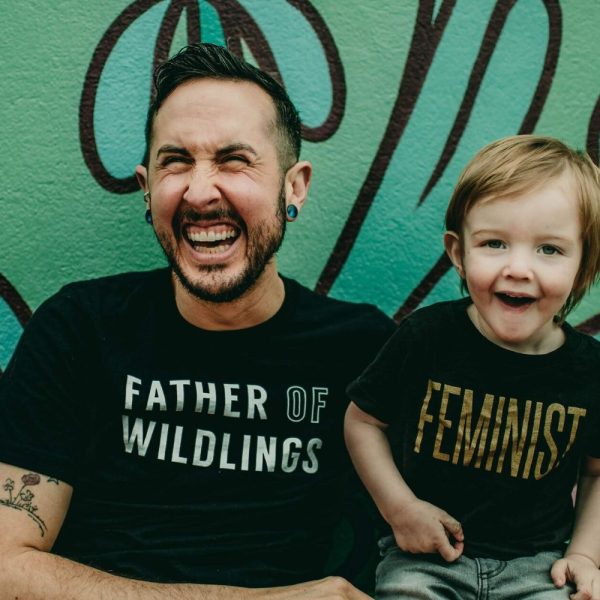
HRS: What was your second pregnancy like?
So I was overjoyed the second time ’cause I was ready. We’d had this amazing conversation, a real turning point in our relationship. Lots more time to think and plan. Lots more time to strategize. We’d actually been trying, planning it out, all the things, cervical mucus, blah, blah, blah. And it was very straightforward medically speaking. That was my joke with my OBGYN team – that I wanted to be the most boring patient she’d ever had, which she thought was hilarious because I was the only man patient she’d ever had. I just wanna do everything by the book. Whatever she told me to do, I’ll do it.
There were lots of extras that I asked for, such as, I really wanted to see the ultrasound every single time. Every time I wanted to be able to see the fetus, which she was not excited about. You don’t always do an ultrasound at every visit. You don’t “need to.” But I am a very effective self-advocate. So I do think at one point, I was like, “oh, I don’t see the ultrasound machine.” She’s like, “yeah, a 12 week visit, we don’t typically do it.” And I was like, “oh, that’s too bad. But , I’ll wait in the waiting room or whatever, if it’s a timing thing. I just don’t really see myself leaving your office today until I’ve seen the fetus.” So I think the subtle threat to camp out at Kaiser was very effective. And she’s like, “I’ll go get the machine.”
It was around that time that I ended up telling my story publicly in the hopes that other trans people would hear about it, in the hopes that parents of trans kids might see it and think like, “oh, my kid has so many more options for their future than I could have ever imagined.” But unfortunately that opened me and my family up to a lot of criticism, including about the health of the developing fetus. I wasn’t being a difficult client to ask to see the ultrasound. It was what I needed to see, just to reassure myself that everything was going okay because I was hearing from so many people that my baby was gonna come out deformed.
HRS: I think that’s a really interesting point and important one, that there are certain extra things that are necessary for your comfort, and reassurance because of external factors. Because of you being trans or other people who also receive extra criticism.
It’s interesting because I teach a lot of birthing professionals and I use that as an example all the time. I was so in it at that time I never told my midwife, “the reason I need more ultrasounds is because people are telling me I’m gonna give birth to a monster and I need to reassure myself that I’m not. Even though intellectually I know that I’m OK I need to see with my own eyes.” I just was so in it, I couldn’t even tell her that. And so, yeah, sometimes trauma-informed care is just believing people when they tell you what they want and what they need and not questioning it. And if you can do it for them, do it for them. What did it take her like four extra minutes to print it out? You know, it’s minimal.
That’s often counterintuitive to a lot of birth workers because they’re used to working with people who don’t want any interventions. And so I have to tell them trauma-informed care doesn’t look like any one specific way. There’s gonna be one type of person for whom extra medical things are gonna feel really invasive. And then there’s gonna be another person like me where it’s gonna feel really reassuring, and to just really trust people and allow them to lead the way and, and to just listen and follow along as much as you can.
HRS: Yeah. It’s so great that you had that care and that you were able to advocate for yourself and that she was able to provide that. And it makes me think about people who aren’t as good at advocating for themselves and/or they have providers who aren’t willing to accommodate.
It’s an issue that trans folks don’t always and shouldn’t have to be good advocates for themselves, for ourselves. Um, it’s also an issue that a lot of providers are not knowledgeable.
And since I’ve given birth, that’s really been a core focus of my life’s work. I created an online ecosystem specifically to help trans people be better self-advocates. It’s just chock full of stories and research and articles and studies and everything so that the average person can print it off and take it to a doctor and say, “no, no, no, testosterone does not cause sterility. Here are 12 studies that indicate otherwise.” Or a trans woman can say, “no, no, no, I want to preserve my sperm before I transition because what limited evidence we have suggests that there’s probably a 50% likelihood that transition is going to make me sterile. Please tell me how to cryopreserve my sperm before I transition.” To really give us the tools we need to be good self advocates. And on the flip side, that’s my other work, doing my best to educate as many providers as possible, both on the principles of trauma-informed care, but also trans fertility in general. Because it’s so overlooked.
HRS: Okay, so you got lots of ultrasounds-
I got lots of ultrasounds. Kaiser did something really wonderful where at some point they were like, “oh, do you know you get free therapy while you’re pregnant?” Like the whole, like through unlimited visits, and like up to three months postpartum. And I was like, “don’t mind if I do.” And so I worked with a really, really incredible therapist. She was just a delight, you know, as a non-trans person. She was so knowledgeable and so aware and just really, really wonderful at being supportive, and she invited Biff into a bunch of sessions to talk about what he could do to support me throughout this process.
And so, yeah, it was very medically straightforward. I didn’t have any complications other than the last few weeks it was super clear that this fetus was a giant, not a monster in the way that people online were talking about, but just a giant, like too big for my body.
HRS: Like a very healthy baby.
Just like a very healthy baby. Big. Yeah. So that was hard. I had rib separation, so my ribs sort of started splintering from my sternum, which is, rib separation. It was brutal. My ribs never really went back. I am now quite barrel chested in a way I was not before just ’cause they never quite healed all the way back on my sternum.
So that was extremely painful. That’s been really painful. And that was when I really experienced what many people who’ve been pregnant experience, it’s the feeling of powerlessness in the system. Because I am a nerd and I’ve done so much research and everything said like, absolutely you can induce a pregnancy at 38 weeks if everything else is normal. And so I start bombarding the medical team with all this evidence. Like, here’s ACOG, here’s ASRM, like , all this stupid certifying bodies, all this research, that I wanted to be induced. At 37 weeks I was having rib separation. At 38 weeks I was like, “this baby is fully cooked. We are ready. We are done.”
And because it was an HMO, because it was Kaiser, they’re like, “that’s against protocol.” And I was like, “cool, break protocol. Who cares? Get this baby outta me.” And they would not do it. And I definitely had that feeling that a lot of people talk about – feeling like I don’t matter. I was literally told the comfort of the pregnant person is not a reason to break protocol… like comfort.
I couldn’t sleep. I was in constant pain 24 hours a day. That is a medical decision that I should have had every right to be able to make.
HRS: So did you have to go to 40 weeks?
The night before my official due date, I called and I was like, “tomorrow I’ll be at 40 weeks. I would like to be scheduled for an induction.” And they were like, “no problem.” And they did it. And I loved, loved the idea of being induced. I loved the idea of being in a hospital the whole time. To have nurses right there, everything would be monitored at that point.
And this is probably a way overstatement, and I don’t mean to sound grandiose, but in that moment my pregnancy had been so public. And I mean like people magazine, CNN. Stupid daily mail did a whole piece on it, fraught with inaccuracies. But it had been a big thing and it felt like the eyes of the world were on me. And again, I’m not trying to inflate my own importance. I’m sure that was not true. It just felt that way at the time. It felt like a lot of pressure I wanted to do right by my community.
And it felt great. I loved it. I mean, it was hard. It’s still birth, but the idea that I was there and I had the monitoring and I could see the little heartbeat and I could see the machine saying when my contractions were, helped with my mind-body connection. “Oh, that’s what that is. Oh, I can feel it.” It was just so reassuring and lovely. And I’m like, “this could have fucking happened two weeks ago.”
HRS: So how did it go once you were finally induced?
Every single step worked as it should. Eventually my body was like, “fine.” It got tricked into going into actual labor. And so like 24 hours of them really gently leading up to the balloon. And then just a little bit of Pitocin a little bit more. It was lovely. And then it was like 24 hours of the active labor piece and I got the epidural, which was a delight. My mother told me in no uncertain terms that my female ancestors would come back to haunt me if I did not take advantage of every pain saving medication available to me. So I appreciated her permission to do that, um, and it was definitely the right choice for me.
And then they were like, oh, it’s gonna be time to push. And I was like, “oh no, I’m not ready for this.” And all the adrenaline that I’d been running on for two days just all wore off. And I felt more tired than I’ve ever felt in my life. And I was convinced that I was just gonna die, just like everything was shutting down. That’s how it felt. Like my heart rate, just everything. Like when people talk, maybe not heroin, but other opioids, like without the high, just that feeling of slowing down. And the nurse told me that I was doing the best job that anybody on the planet was doing right now.
It was very helpful. It’s like, “you’re right, I’m doing the best job. I love that.” So she gave me good pep talk and they pulled out the stirrups and I scooched down and all of a sudden the room was a delivery room, which I didn’t know it could do. Push a button, the lights come out and I had to push.
I pushed and pushed for about an hour and they threatened to take out the epidural if I couldn’t push well enough. And I was like, “watch me.” They told me to push, and I started screaming like they do in the movies, and they’re like, “no, no, no, don’t do that.” And I was like, “but that’s what they do in the movies.” And they’re like, “that’s fake. Put all of your energy into the push. Don’t put any energy, don’t let it out screaming. Put it into the pushing.” And then I threw up all over everyone. I’m like, “I’m so sorry.” And they’re like, “do not apologize. Just push.”
Yeah. I pushed him out. There’s like a big wet sucking sound and then all of a sudden there’s a person, a whole human who wasn’t there before that’s been my little buddy for nine months. I’ve been giving him everything. I’ve been singing to him and talking to him, and then he existed, and they put him in my arms and he stopped crying immediately on my chest. It was just so sweet and tender. And he was not a monster at all, but he was nine and a half pounds.
I had had hemorrhage, I almost died. I had tears. He was a huge baby. And I’m a small person and I’m sure I said to the nurse, “you know, when he wouldn’t have been nine and a half pounds? Two weeks ago when I was calling begging you to induce me, this could have been much easier for everyone.”
My family rushed in pretty quickly. Everyone wanted to hold the baby. Of course. My mom rushed to me and realized that I was going into shock. Like she noticed. The nurses did not notice. She was like, “his teeth are chattering. He’s shivering. Like, where are heated blankets? Why isn’t anyone paying attention to him?” And she’s like, “this is so typical. As soon as the baby comes out, no one cares about the person who had the baby.” I was like, “I’m so glad you’re here, mom.” And so they gave me special medication to help clot the blood and help me come out of shock.
HRS: Your mom sounds amazing.
She hardcore. She’s hardcore. Exactly what you want in those moments.
And then we just had the most wonderful 12 hours of resting. And the nurse came in and was like, “why’d you let him sleep for 12 hours? You’re supposed to wake him up and feed him.” And we’re like, “well, how would we know? We’ve never had a baby before.” You know, the other kids were toddlers. We didn’t know what we were doing. It was just so cool to see his little- he looked like Voldemort. He had these long fingernails. I told you he was cooked, he was ready to come out. He was just giant. He looked like Grumpy Cat. He had these big fat cheeks.
HRS: I imagine that the scrutiny that comes with being trans and pregnant, is a lot and overwhelming. But then add to that, being semi-famous from this experience, that was exponential.
Yeah. There was one time, it’d be like six or seven months into the pregnancy when our story had blown up and there was all this backlash and it was so harmful to me. I remember I had been trying to nap and I woke up just sobbing and crying. And I came downstairs and Biff was like, “what’s wrong?” And I was like, “why did I do this to myself? This was a really, really stupid thing to have done.” I was embarrassed. I was ashamed. I had no one to blame but myself, you know, I just felt like I was so naive in not realizing both how incredibly tender I am, and how incredibly cruel the world was. Even though people tried to tell me, I didn’t listen and I really should have listened.
And often people will come to me and be like, “well, I wanna be famous like you were. I wanna tell my story publicly.” And I just tell them, “don’t do it. It’s, it is not worth it. However you think it’s gonna go. It is not. It is not.” And usually they ignore me and one person is still in inpatient psychiatric treatment because of how awful it was him telling his story publicly. His partner is a single parent to their kid. The brutality that is foisted upon public, trans people is not something I would wish on my worst enemy.
HRS: Would you have still wanted to tell your story publicly after the fact? Like would it have been different if you hadn’t done it during the pregnancy?
I don’t think that people would’ve been interested in my story after I’d already had the baby. The shock and awe of the pregnant man I think was what really drew people in. I was a trans parent before and I wasn’t in People Magazine. I mean, actually I was in People Magazine, but I wasn’t in the Daily Mail. I wasn’t on CNN, I wasn’t on the front page of the Washington Post. Nobody cared. Before, we were just two people raising two kids. You know, it was really the pregnant man. That was the thing that really drew people in. And I don’t know that I would’ve ended up doing the work that I do now.
Like for me, a huge impetus moment was when Leo was about six months old. We went to a conference, Biff, I went to a conference together in DC- a big LGBTQ+ conference, and we are in the rotunda at this fancy hotel, and there’s just hundreds of queer people from all over the world around us. And this very tall Black trans woman comes up to me and she’s like, “oh, can I hold your baby?” And I was like, “of course you can.” And she’s holding him and then she starts crying. And I was like, “sister, what’s going on?” And she said, “I know who you are. I saw your story, and until I saw your story, I never knew a trans person could be a parent, and now it’s too late for me.” And for me, that was the moment when I was like, oh, this is my work. Like, this is my life’s work. It’s unconscionable that trans people don’t know all the choices available to them and cannot really make informed decisions about our health, our futures, our transitions, our bodies, if we can’t even imagine a future where we could be a parent, because we don’t have enough possibility models for that, and that we’re allowing people to close a door on a part of their own future that they don’t even know exists. And so if I hadn’t told my story publicly that moment never would’ve happened.
The vast majority of trans people who go through any fertility process do it very quietly. Maybe their friends and family know, but largely when they, if they’re pregnant and they start to show, they work from home if they can. Like, there’s a whole section on my website about how to dress to cover up your pregnancy. Like what different layers can you use? Where can you buy pants that are gonna be gender affirming and also have a nice expandable waist, you know?
So most people do not, are not subjected to a high level of scrutiny because we do it quietly. We find ways to build our families in ways that don’t invite that level of attention and violence.
HRS: And you mentioned before that you never wanted to be in the closet, you never wanted to hide your identity because of the dangers of that. And I can see how this also would come with dangers, you know, not being able to talk to people about it, having to hide.
Yeah. There’s a great study that looks at survival strategies. Basically it wasn’t the focus of the study, but they happen to ask, you know, which is always for me, where the good data lies, is what do they happen to ask and what can we learn from it?
And they really found that trans people who go through pregnancies can basically choose two out of three options. They can be safe, they can have support around their pregnancy or they can have support around their gender identity. They can’t have all three.
So you could be an out public trans person who’s having a baby like I was, but you’re jeopardizing your safety. You can be stealth and have support around your gender identity and have everyone see you as a man. Um, and you can be safe. But then where do you get that support for your pregnancy? You can’t go to the prenatal classes, you can’t go to the labor and delivery classes. Some people, there’s not a ton of data on this, but a certain percentage of people get zero prenatal care, period, because they’re too afraid to even have a midwife come to their house. They do not trust medical systems, period. Which in some cases is fine, in other cases, not at all fine. Um, because it is good to get your folic acid. It is good to have someone notice if you might be getting gestational diabetes or hypertension or any of the things that could be really deleterious for you, for the pregnancy, for the fetus. Or the other option that sometimes people do, particularly if they haven’t been on testosterone, is they pretend not to be trans and they just live as a woman. And then they get support for their pregnancy and they’re safe, but they don’t have their identity affirmed, which is really, really traumatic and can cause long-term psychological impacts. So it’s an impossible decision that trans people are expected to make. I really support people around these three pillars.
They might not be able to get all three everywhere, but can they get all three in some ways in different places?
HRS: I mean, it’s just so obvious the harm that discrimination does and this slander and awful things that people will say in the name of, shame and discrimination and fear, can cause the things that they’re saying.
That’s the irony of a lot of the anti-trans messaging is they’re like, “well, you shouldn’t be trans because trans people have more depression.” And it’s like, well, we don’t have depression because we’re trans. We have depression because people like you are creating transphobia, which we then would have to deal with. You know what I mean? And so something like trans pregnancy is not inherently any more or less dangerous than any other pregnancy. Might we have (and there’s no data on this yet, but I’ve been asking for it for many years) might we have a harder time in terms of our mental health? Probably. Because we don’t have ways to access the things that we need that other people get access to. And so someone could say, well, trans pregnancy is inherently more dangerous because they have worth me mental health experiences. No, the unsupportive systems cause this other thing.
And so yeah, it’s like the snake eating its own tail or whatever, you know, you telling us this message is actually what’s causing it. But yeah, that’s one of the three things I’ve been pushing for in terms of research is much, much more data on the mental health experiences of trans, non-binary, gender nonconforming, any queer folks going through a pregnancy process. What are the correlations between the types of supports they get during pregnancy and positive mental health outcomes? Because they want us to be thinking holistically as a community. How can we replicate what worked well for people who did have good experiences? How can we start to build that into our systems?
HRS: So for you, you said you had free therapy for Kaiser, which is pretty cool. Did you have like a mantra or something that really helped you get through that difficult time when you were getting a lot of criticism and scrutiny from the public?
I didn’t have a mantra or anything that helped me get through, when I was getting just deluged with really violent and toxic , and life threatening messages from people. I just eventually was able to set up some good systems to keep me away from that. But it’s very hard to let the good stuff in without the bad stuff too, so occasionally I would get a really amazing message. Like this woman from the Midwest emailed me to say that she had also raised her sister’s kids, and she said oh, I think it’s amazing that your body is able to create new life while also giving you the life you deserve.
And that’s, that’s what I was trying to do is help people see Por que, no Los dos? Like why can’t you have both as a trans person, like you can live the life that you deserve and create new life. You could have both as a trans woman, like you could be a parent in transition, like you could do both. And the fact that someone saw that was a good reflection.
I worked so hard on the messaging and tailoring every interview I gave to that specific audience and all this research and sending it to messaging people for feedback. How did I do, how can I improve? Um, to have it land in that way was like, okay, yes, it’s working, but how do you let that in without also letting in the, like hundreds of messages, about what a circus freak I am? And the only way I figured out how to do it is not let any of it in and to have other people do it for me.
And so, yeah, my friends really rallied around. Like every straight cis dude in my life was like, “I got you.” And they’re like, monitoring all my accounts or deleting and blocking people. They’re reporting credible threats the way that they should, which was really nice.
HRS: Did you have anybody in your life, in your circle who you were surprised at how well they responded?
I think even the way that I’ve described my dad so far, I was really blown away by my dad’s response. My parents would come down to visit and he’s like, feeling my belly. And he is a doctor, so he’d be like, oh, there’s an elbow. Do you wanna feel the elbow? And I’m like, yes. Like just for a boomer, for a 75-year-old man doctor, you know, it would never have occurred to him to have any questions or judgment, it just felt great to be treated like any other person expecting a baby. He just never had a single question, there was no judgment at all. And so I think that was really wonderful and. I mean, it’s sad to think about, but like, how many other trans people who have babies have a parent who’s just unconditionally supportive, excited, happy, touching the belly?
Um, I know that pregnant women really hate having their bellies touched, but I started to resent the fact that no one wanted to touch the belly. You know, there would be times when I would literally be like, oh my God, like the fetus is moving. Do you wanna feel it? Like, it’s so cool and weird.
HRS: Like, I don’t touch random men.
No one touches random men, you know? Which is good. It’s fine. And there was a certain point that I was like, oh, people were so careful around me. That I’m like, I mean, come on. This is cool and weird, right? Like, he’s hiccuping and you can feel it if you put your hand on my belly. Like, that’s so cool and weird.
HRS: It is the coolest, weirdest thing. Yeah. The feeling of a baby moving inside your body. It is so cool and weird. There’s really nothing to compare it to.
No, no. I loved it. And it was gross, but it was also so cool. Yeah. So my dad was a good surprise.
And Leo has been like, he’s been nothing but a true joy and a blessing since the minute he was born. Like, he’s just been amazing.
Thank you so much. Anything else? What didn’t I talk about?