
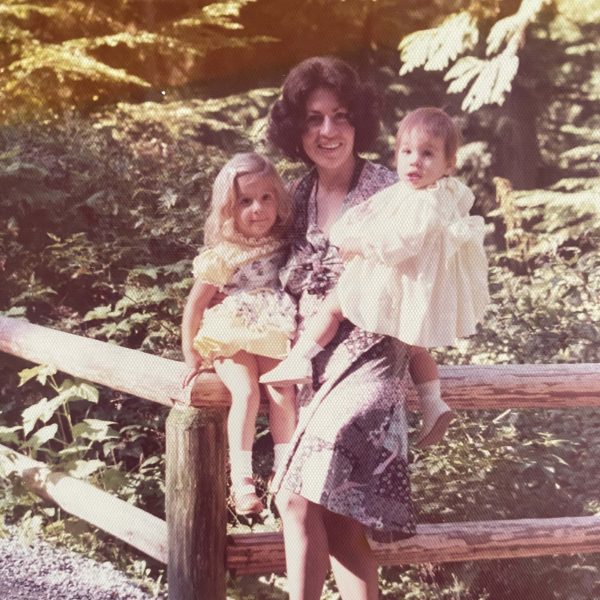
Well, I was 22 years old, got pregnant. I gained about 16 pounds. I was bleeding a lot and I went to the doctor and they said everything was okay. I thought I was having a miscarriage but they said, no, everything’s okay. So I continued my pregnancy. I decided I was not going to do it natural because I was scared, so, I decided I would do an epidural. So, I had that done and then they said, “Well, it’s time, you just have to push.” Well, when I pushed, nothing was happening and then they said, “Okay, push again.” And so I did, and finally the doctor used forceps on Nicole and started pulling on her. She was born, of course, and being 22 years old I just assumed everything was okay.
And when I was in the hospital, I kept hearing a baby crying all night long. And I’m going, “Gosh, can’t they do something with that baby, poor thing.” Well, my husband went home, slept. And then the next morning I was supposed to leave and I never got Nicole. So, I said, “Well, aren’t I supposed to have the baby come to me?” And, and they said, “The doctor wants to talk to you about this.” Then I thought about the crying baby. And so I called Dave, “Get up. Get over here right now. The doctor wants to talk to us about Nicole.” And so he rushed over and he sat us down and said she was very sick. She was hydrocephalic.
So they rushed her across the street to Children’s Hospital and they operated on her and put in a shunt. They waited like three days and then they put a shunt in her. And all that time I kept thinking, did I do something wrong? Did Dave do something wrong? They never gave me any answers as to why this happened.
Interviewer:
But you didn’t have her that whole first day?
No. And again, like I said, I heard a baby crying. And they didn’t say anything. They just took her to the hospital and she had the surgery and she was there for about a month. And then I was allowed to bring her home. (The shunt) was going down her neck and into her stomach for drainage. And I had her for, I guess about a month later, and she was vomiting projectile. So we took her back. And then she was there another month. She was there like five times.
Finally, the last time that she went in, I called her neurosurgeon at three o’clock in the morning because the stem or the shunt was coming out of her incision on her stomach. And he said “Well, it’s the middle of the night. Just come in tomorrow morning.” And I said, “But the shunt is out.” And he said, “Just bring her in the morning.” So Dave and I took her, but she was throwing up. And then she was crying and crying and crying. I walked into the neurosurgeon’s office and there were a lot of people there. and she was crying so much and I didn’t know what to do. And he came out and said “Can’t you keep that baby quiet?” And I’m going, “Do I take her to the hospital? What do I do?” And this older man, he said, “She can take my place.”
So we went in there and he pulled her, I think I had her in a little dress or something, I don’t remember. Cause it was like, oh my gosh, maybe nine months later and she’s had five surgeries. And, um, he, He looked at her and he goes, “oh my gosh, why didn’t you tell me?” And what was I supposed to say? “I mean how much more could I tell you? I’m not a doctor, I depended on you. You’re a surgeon.” He says “We’ve got to get an ambulance to take her back to the hospital.” And Dave said “No, I’ll take her.” We just went across the street, and that was probably the first time I saw him break down.
But during that whole time we had a postoperative doctor and he said, Nicole was doing great in between surgeries. And he said something like Mark Twain was hydrocephalic and Nicole is just, she’s above average. And I was happy about that, but it was the surgeries that were constant. He walked into the emergency room while Dave was crying on the floor, and I got brave, and I saw him and he says, “What are you doing here?”
I told him about Nicole and he went to go look and came back. He said, “I have this card. I want you to give it and call this doctor.” He says, “Please don’t tell your doctor I did this because I take care of most of his patients.” And I said, “What are you talking about?” “Just do what I said.” And so Dr. ——– came over and he said to us, “We’re going to keep her in the hospital. We may have to transfer the shunt from one side to the other.” And I’m going……….ugh.
So he said, “But I’m going to San Francisco. I’m going to take her report. We’re going to have a conference there. We’ll talk about this and I will be in touch with you.” And he says, “My assistant will come see her every day to check on her.” And I said, “Well, you know, maybe you could get Dr. ******.” And he says, “Oh no, do you want me to just switch all the paperwork to him? He can just take over.” Then I got scared, like, I don’t even know this doctor. I haven’t met him or anything. And I said, “Well, I don’t want your associate to handle it. Maybe another doctor with different eyes can —” And he says, “I will be in touch with you.” I said, “Fine.” So he went.
Well, the next day I was in the hospital sitting there and the doctor came in. Dr. ****** came in. I didn’t call him. I think the postoperative doctor called him. And so he walked in and he says, “I was here last night and I was here today. And my advice to you is I think it should be removed completely.” And I said, “Well, what happens if she has an episode?” He says, “If they remove it, she’s going to be here in the hospital because they’re going to have to look at her. If she’s in trouble again, they will rush to put another shunt in her. But there’s hardly any fluids coming out. I think she’s doing it on her own. And I said, “Well, should I tell Dr. ——–? And he goes, “Yeah, I think you should.” And I said, “Well, I’m scared.” And he goes, “Just approach him with that, that you have decided to stop this and have her stay in the hospital a couple of days to be watched.” So right after he left, Dr. ——– called me from San Francisco and he says, “Well, I’ve arranged for her to have surgery.” And I said, “Well, what would happen if you took it completely out?” And he says, “That’s kind of a dangerous thing.” And I said, “Well, what’s the percentage?” And he says, “well, if we have to go in emergency — And I say, “Well, can we do it? Is it safe?” And he says, “I’ll get with you tomorrow.” So he came in the next day. And he said, “We’re going to do that.” And so they did. And I don’t know how long the surgery was, but I was sitting there. Dave didn’t come because his office wouldn’t let him come.
He had been there too many times, taking time out. So I was so scared. I’m waiting so long and there were so many people in Children’s Hospital. It was just a sad day. So I told them I was going to sit outside, could they just call me when the surgery is over? Well, they didn’t call. It was like an hour, maybe an hour and a half and I went back in there and I said, “Dr. ——– hasn’t given me a call.” She said, “We’ve been trying to reach you.” I said, “I was right outside.” And she says, “He’s coming right out.” And he came out and he was smiling and he said, “She’s perfect.”
They didn’t let me see her until that evening. So I went to the store and bought her a little dress so I could take her home. Dave and I walked in and went to her room. She was in ICU and I went in to see her and she wasn’t there, and I freaked out. Well, so we went back and they were strolling her in a red wagon, and she was sitting up, looking great.
But she never had a problem after that. She never did have a problem after that.
Interviewer:
What an experience for you though, I mean, that was nine months?
Almost ten months. Almost ten months. In the hospital, in and out of the hospital. So she was, she was never nurtured like most babies. And then of course, when she was growing up, I was like the worst helicopter mom ever.
I didn’t want anybody to play with her because I didn’t want her to get hurt. I was always around. And when she started school, a little kid liked her and wanted to walk her home one day and she said no. It was show-and-tell and he took a trophy and he hit her over the head with it. Yeah, it was scary.
I mean she’s okay now. She’s got scars, but you know, what an experience with a doctor that —
When I had Monica, it was so much easier. It was nice. I wasn’t working. And she was great. I gained Probably 60 pounds or 50 pounds. I ate everything. I wasn’t going to let anything bother me. I could care less if I put weight on. When she was born, she was nine pounds, two ounces. She was healthy and happy. And with her, when I went into the hospital, Dave and I had done Lamaze the whole time. He knew more than I did. By the time I was having contractions it was painful, and when you don’t have an epidural you have to go through the pain and I was, like, dying. So he kept saying, “You have to do this.” I think I called him every name in the book. And then finally, he had no control of me, because it hurt so bad. And he started telling me to add numbers. And I said, “What?” So he’d go, “What’s 42 and 25?” I was answering it so fast as they’re throwing me into the labor room and the doctor came up. It’s Dr. ++++. I’ll never forget her. She’s a tiny lady and she says, “What are you doing?” And he had a calculator with him cause I was answering it faster than — And he said, “She will not listen to me, you know, breathing or anything. All she wants to do is— I’m just making her add numbers.” And she goes, “I’ve never heard of that.” And he says, “Well, it’s kept her mind off it and she’s not yelling at me anymore.” So she allowed him to see the birthing stage, but he said she was so big. And Monica came as soon as she said it was time for me to push. I pushed so hard that she had to grab her skirt and grab her like that. She just shot out. She goes, “This little girl wants to get out!” So that was, that was that. That was good.
Interviewer:
After having your first baby, you didn’t want to have another one after your first experience?
Dave wanted a second one because he was an only child. And he says, “I don’t want Nicole to be raised by herself.” And so we had another one.
Interviewer:
Were you scared?
Yeah. I think that’s why I over-ate. I think that’s why I was a helicopter mom for a while. It wasn’t as hard with Monica because I was home and Nicole was with me the whole time and she and Monica got along really well. I mean, I breastfed her. So we were both on the rocking chair together and then she would go answer the door, and she would say, “My mom’s feeding the baby.” Then she’d come back.
And after, I think, when Monica was four, I wasn’t a real good stay at home mom. I mean, I was good at it, but I always thought it’s not fair for me to raise both girls. I wanted Dave to have the experience. He was working a lot, like even on weekends, and I didn’t like it. So I thought, well, maybe I should do something to earn a little bit of money and then I could get out of the house and not be, you know, stifled. I just didn’t like that. And he was such a good dad that I could do it because he cooked and he cleaned and he did, you know, like most men don’t do.
It was easy for me because my parents gave us help. So I went to school thinking, “What should I do?” And then I thought maybe I’ll just go learn to cut hair and just do it for the family and not really get a job. But then I became good at it, and it just ended up being good for us. Dave didn’t work weekends anymore and he was home.
Monica, we put her into a little nursery school thing and she was home by three o’clock, and he went to work really early and then came to pick her up. And then the next door neighbor said she wanted to babysit Monica because she didn’t like the nursery school. So she took in Monica and then Nikki was in school. So it turned out to be okay.
Interviewer:
When you were in the hospital, what was it like to be able to hold her right away?
Oh my gosh, way better. The experience with Nicole was horrible. But I was lucky. Dave used to say she’s our miracle child. But maybe it wouldn’t have happened if I hadn’t done that epidural – if I would have had her natural. And so every time I talked to somebody I said, you know, are you going to do it natural? And, you know, they said, I wish I could tell you my experience, but I don’t want to scare you.
But I don’t know. I had heard about forceps, but I didn’t understand. It was awful watching him do it. I thought, this isn’t right. You know, because she wasn’t breech. So I couldn’t understand. And the funny part about it is I couldn’t feel anything when I was having her. You know, I thought, where’s the – do you get a little bit of pain? And I remember the nurse going behind me and she was pushing (on my stomach)! And I went, is this how it’s done? I mean, I never asked my mom because she didn’t have any problems and she always had us at home. Um, but yeah, that was, that was crazy and I never went back to that doctor again. I think I just got an OBGYN doctor, I can’t remember. I didn’t want to even go to the doctors anymore for a while, but I had to get her, her shots and do everything else.
Interviewer:
What causes hydrocephalus?
It’s um, water on the – on the brain, I don’t know.
Interviewer:
Is it a congenital thing?
No, no, it’s like, uh, well, I don’t know if it is that. But, like, Reagan fell off his horse and hit his head and he got hydrocephalus.
Interviewer:
So it could have been trauma from the forceps?
It might have been. And nobody said anything. That’s what’s weird, you know.
That’s why— talking to the neurosurgeon. I was so afraid of him. I think one time Dave said something to him about, “Could you not talk to me in physicians terms? Could you talk to me in layman’s terms?” And he got really angry. Like we were some kind of idiots or something, that we shouldn’t have been asking questions. But when you’re so young… Maybe now, somebody would say, “Wait a minute, you need to tell me what’s happening.” But he wasn’t very patient.
So, years later, when I was cutting hair, I had a new client come in, and it was Dr. ******. And I said to him, “Are you a doctor?” And he goes, “Yeah.” I didn’t remember what he looked like. And I said, “Did you ever work for Dr. ——–?” And he goes, “Yeah, I did.” And I said, “I never called you to thank you.” And he says, “For what?” Then I told him the story. I think Nicole was probably sixteen, eighteen years old then. And I said, you always said, every time we walked in, that she was the brightest one that you’ve ever seen with that kind of trauma. But, yeah, it was kind of cool, you know, to see him. But, that’s my story.