
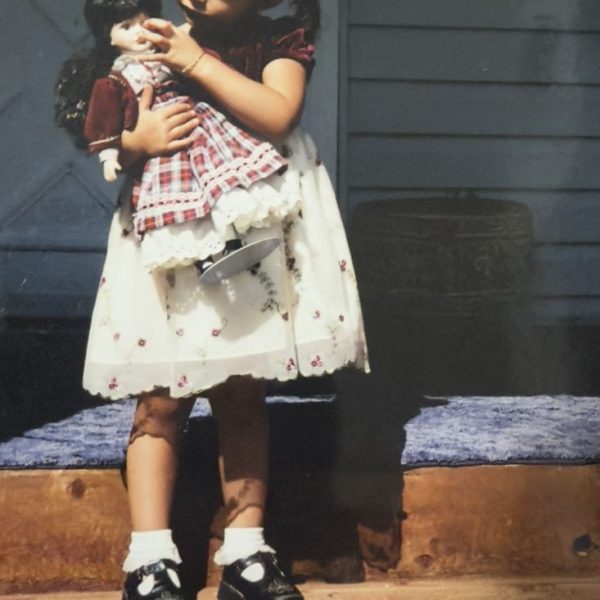
One way to sort of start this is, when I got married, the questions started immediately — if not before, when people found out that we were getting married. Like, “When are you gonna have kids?” This was at work, where I worked with kids, so, definitely the women of older generation were asking this question a lot. And when I would respond, “I don’t think we’re going to have kids,” they would respond with, “Well, you’ll figure it out,” or “You’ll change your mind later,” or something. And you know, I was mid-30s when we got married. So this assumption that we don’t know ourselves, that we don’t know what we want, that it’s an immature decision or that it’s selfish is just not the case. I’ve put so much thought into it.
I also was not somebody who wanted to have kids growing up. I had a baby doll who looked like a real baby. Her name was Lissy. Wherever that came from, I have no idea. But she was life-size. I was not her mother. I was her babysitter or her big sister, you know, whatever. I was her caregiver, but I was not her mother. I don’t consider myself my dog’s mother. When people say to me, “This is what she’s saying about you,” and they call me her mom, it always gives me a little twinge of, “Ooh, that’s not quite right.” I’m her big sister. I’m her babysitter. I don’t know. It’s still that. It’s still really very true for me.
And then additionally, I was raised Christian. I’ve been really processing this lately. I’ve done a lot of therapy. There’s a lot of re-parenting of myself that’s been happening in the last decade. But I was raised Christian in a community that was very liberal, but there was a lot of perfectionism, and a lot of pressure around, how are you the best woman that you can be? So I think that I always thought that I would change my mind also because of that. Like, surely at some point, I’ll be more like all these people that I’m surrounded with, and clearly this is the best way to live my life, even though I think I knew at a young age that that was not what I wanted.
The last thing I’ll add in terms of the moments of judgment…I mentioned my sister, who has two kids. She’s three years older than me. And sort of in the same way of growing up in a church community where there was a lot of perfectionism, there was also a ton of that in my home growing up, a lot of complex dynamics there. In my family of origin, everybody needs to be the same. You know, obviously we’re family members, but everybody needs to have the same hair. Everybody needs to like the same things. Everybody needs to be a vegetarian. Everybody needs to be the same. It’s very culty. It’s not good. And so this pressure from my sister to be like her as a reflection that she has made the right choices has been really hard for me to kind of accept… that this is what I want and that I feel good about this. She actually said to me, “If you have even a small inkling that you want to have a child, you should just go for it. You should just do it.” And I really, really deeply disagree with that.
I think that you should really want to have a child if you’re gonna do it. [It] changes your whole life, and a child should be wanted. So many problems in our world come, I think, from people who had really traumatic upbringings or were unwanted by their own parents. And so I think my way of dealing with those kinds of comments, not only from my sister but from other people, is just to get out of that conversation as soon as possible. Just, deflect, change the subject, whatever. And I want to, going forward, have a more direct answer. And that’s something I think I’m still kind of, kind of working on.